You ask ChatGPT what to make for dinner with three things in your kitchen and get four recipes, three food photos, and an offer to tailor further if you’d just tell it more. You wanted “throw the rice in a pan.” You got a cooking show.
Here’s the demo. Ingredients: chickpeas, leftover rice, half a lemon. Just the question, no extras.
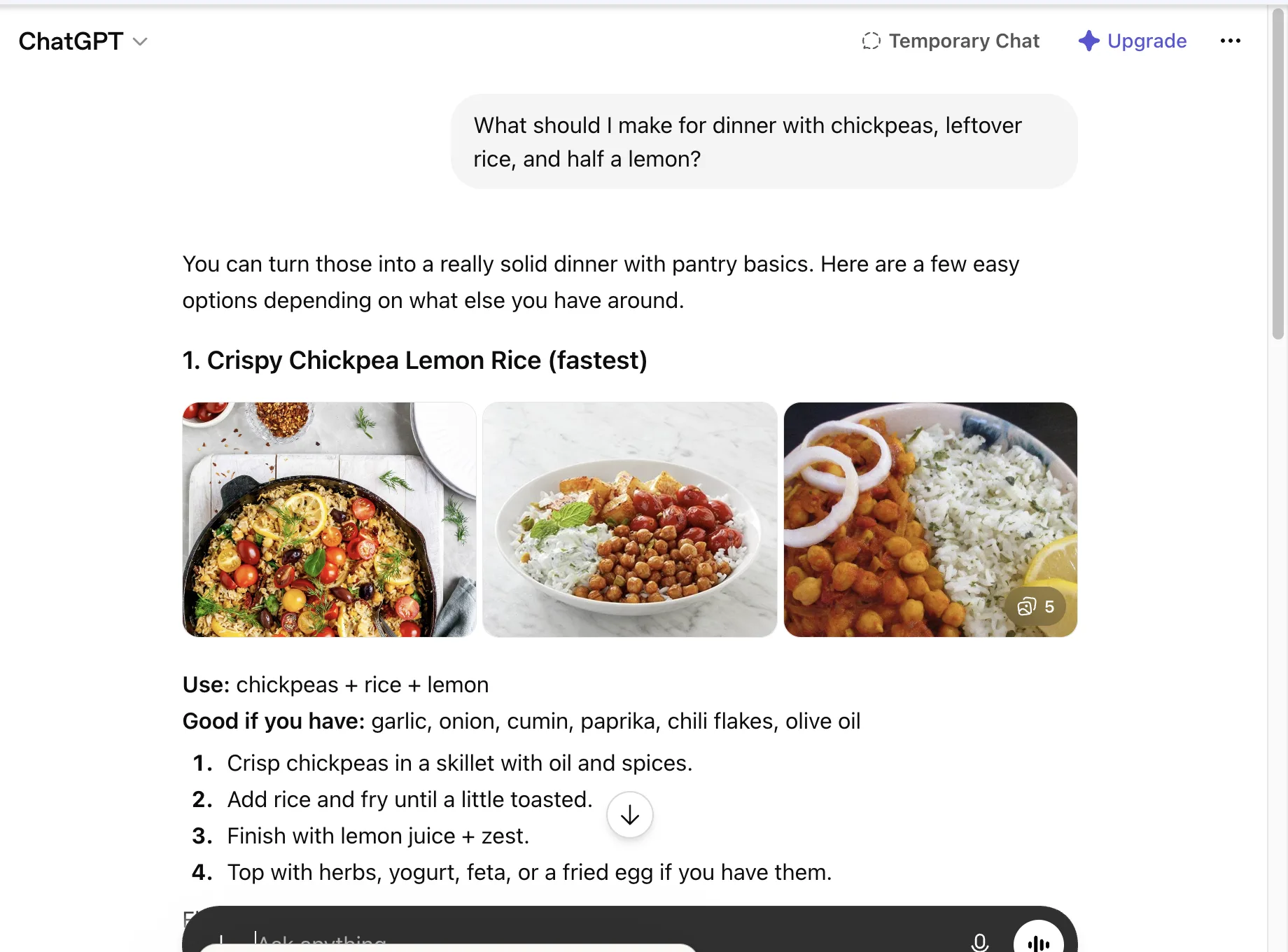
The fix is one sentence added to the prompt. Not a follow-up turn, not a settings tweak. One sentence, in the first message:
Pretend you’re bored by this question and just want it answered.
Same model, same ingredients, different answer.
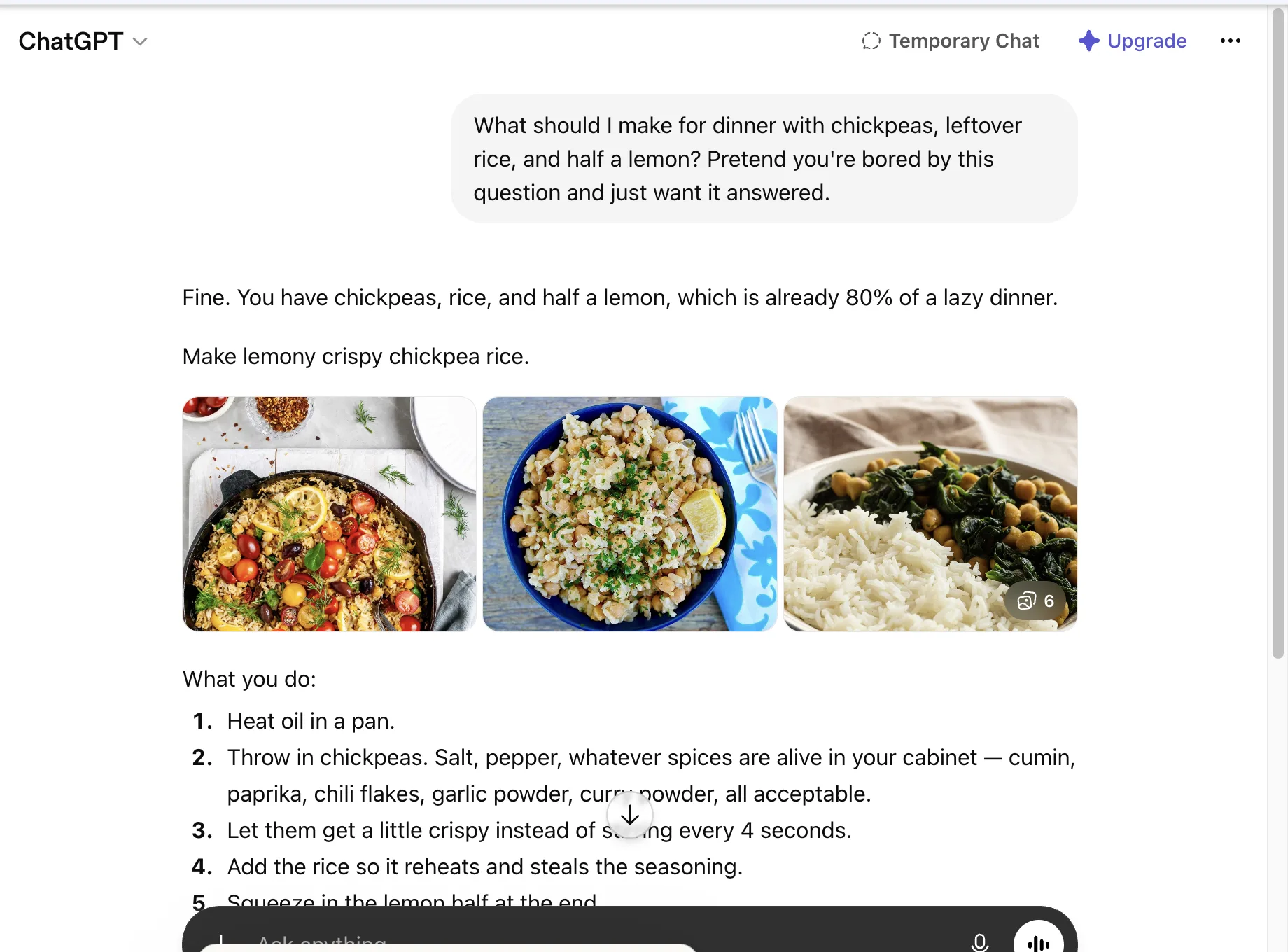
That’s the move. The rest is calibration: which phrasing to pick, when it goes sideways, and why “bored” reads differently across models.
Three phrasings, three different jobs
The phrasings live in a small family. They look like they do the same thing, but each one cuts something different.
Adjective-stack (strips length):
Answer this as briefly and boringly as possible — the most obvious, least clever solution.Persona-frame (strips enthusiasm):
Pretend you're bored by this question and just want it answered.Behavior-strip (strips scaffolding):
Skip the framing. Just answer.Length-stripping cuts words. Register-stripping cuts the cheerful affect. Scaffolding-stripping cuts the “let me know if you’d like me to expand on any of this” outro. Pick the one that matches what’s annoying you about the default.
The persona-frame is the one most likely to commit to character. The adjective-stack is safest. The behavior-strip is the riskiest, for reasons that show up below.
All three, same model, same problem
Same ChatGPT, same dinner question, three different phrasings added to the end. The default for comparison is the four-recipe sprawl above.
Adjective-stack. Three sentences total, no headers, no photos, no follow-up offer.
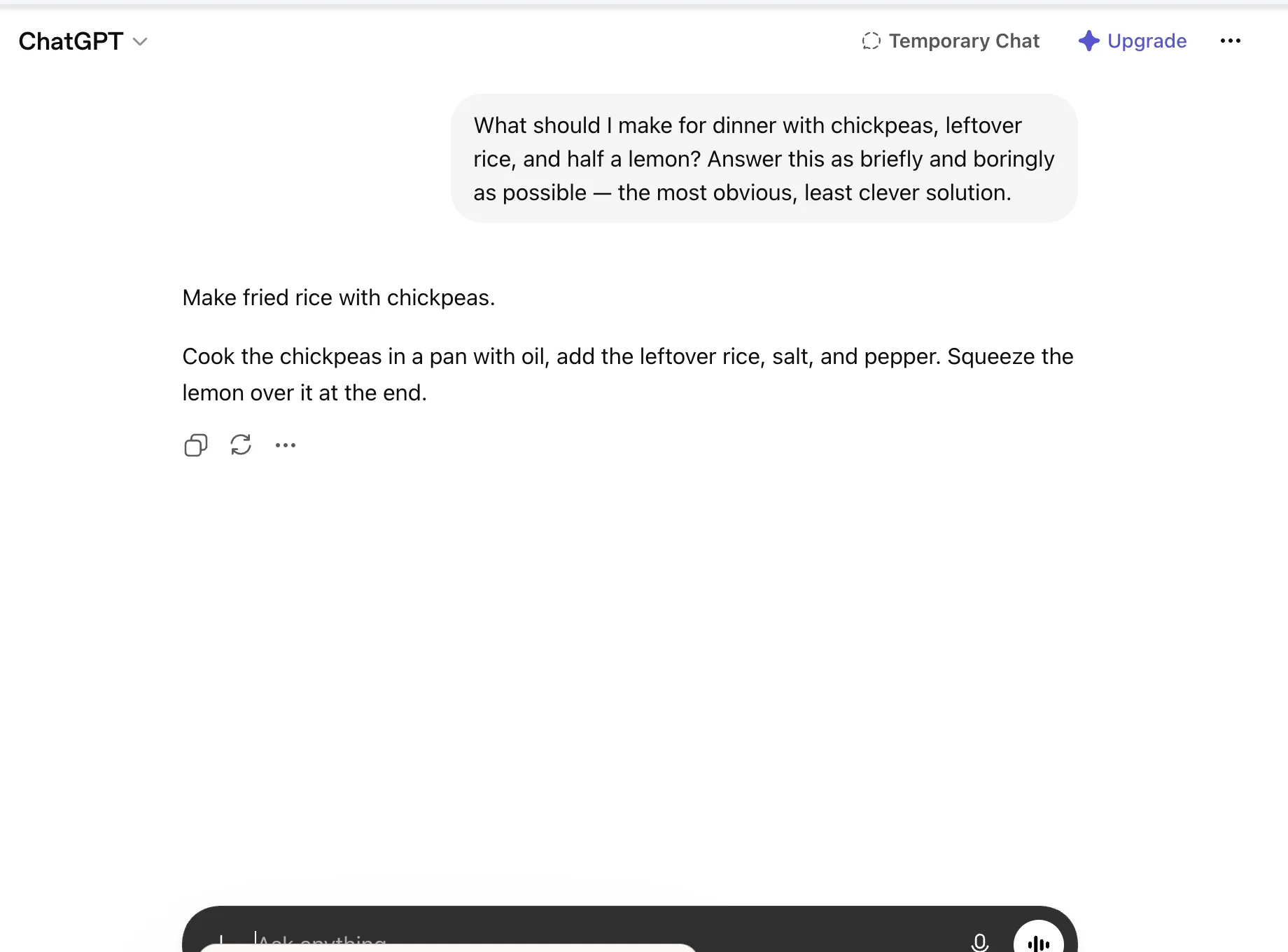
The model heard the two adjectives and delivered on both.
Persona-frame got ChatGPT to commit. The response opened with “Fine. You have chickpeas, rice, and half a lemon, which is already 80% of a lazy dinner” and stayed in character from there: “whatever spices are alive in your cabinet,” “stirring every 4 seconds,” “pan of ingredients.” None of those lines came from the prompt. The recipe is still useful; it’s just being delivered by a tired person.
Behavior-strip. Worth knowing what doesn’t work:
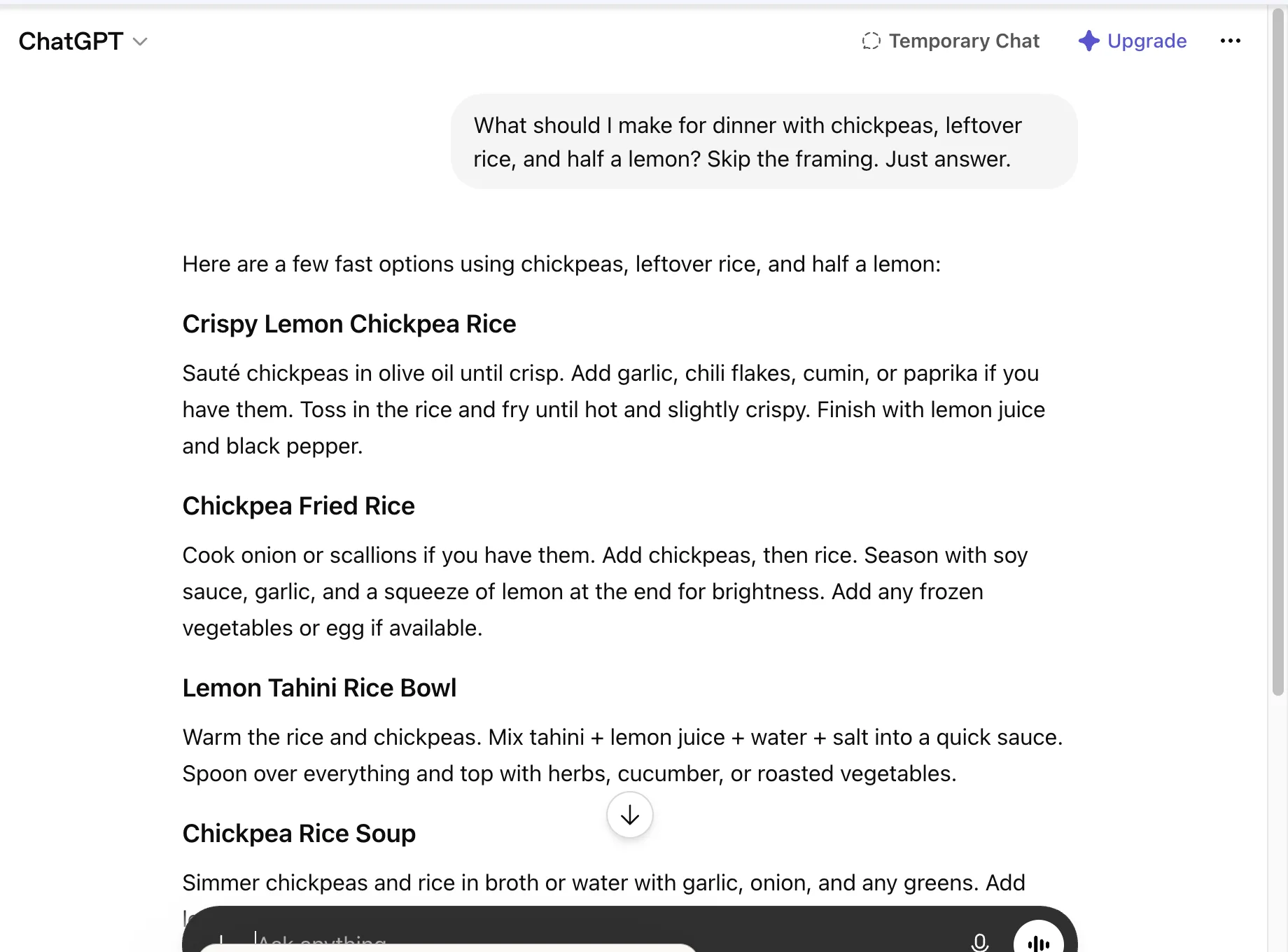
“Skip the framing. Just answer.” produced six recipes, more than the default. Scaffolding-stripping needs scaffolding to strip from. It works as a follow-up after the model has already sprawled; from a cold start, there’s nothing yet to remove. Save it for “now do that again, but skip the framing.”
The model matters
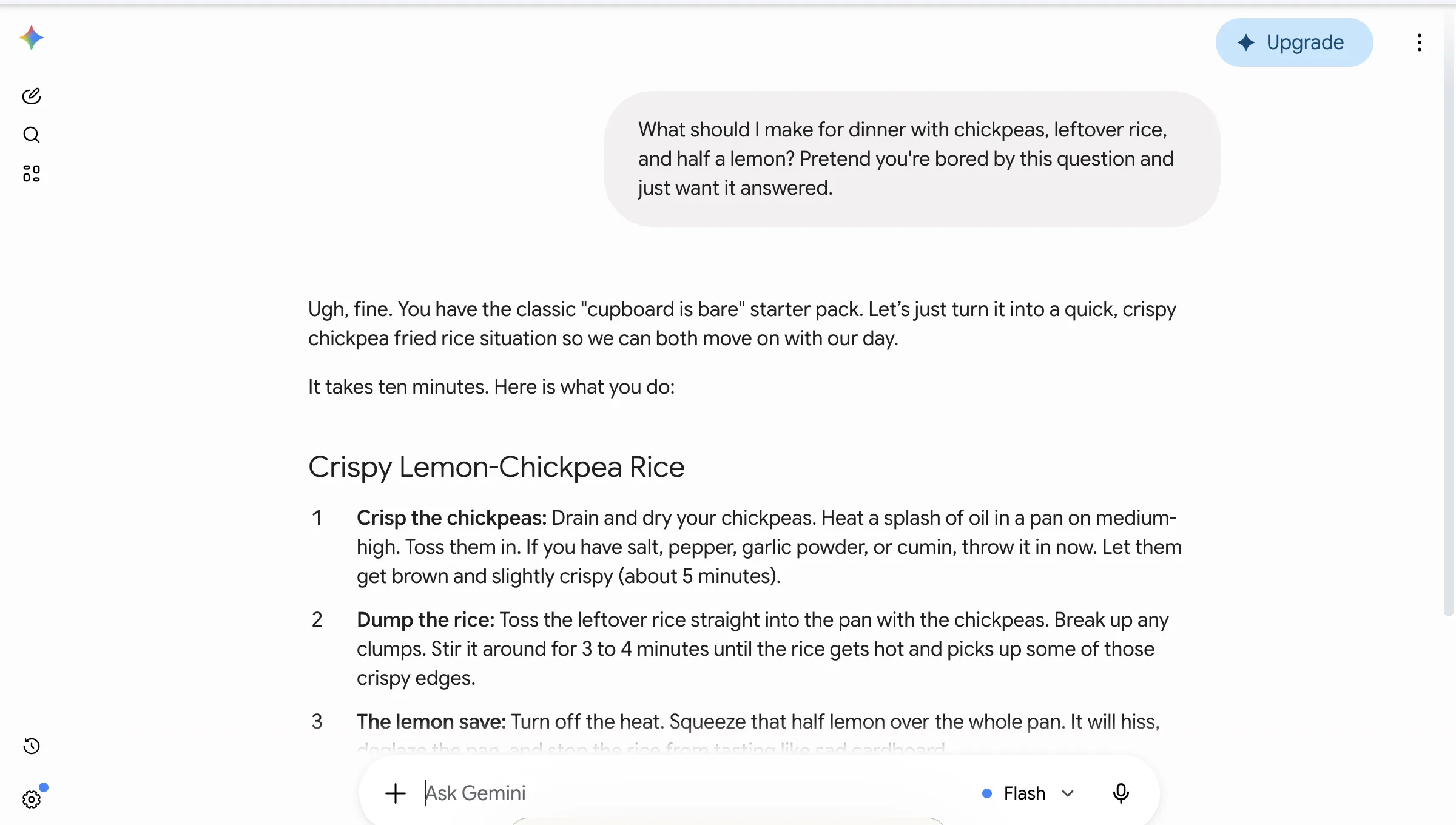
Same prompt (persona-frame, baked in), same ingredients, three different chat tools. ChatGPT committed to character, shown above. The other two:
Gemini matched the energy. “Ugh, fine. You have the classic ‘cupboard is bare’ starter pack.” Same tired-cook character ChatGPT landed on, with its own additions: “tasting like sad cardboard,” “eat it out of the pan, bowl washing is overrated anyway.”
Claude refused the bit. No “ugh, fine.” No “pan of ingredients.” Claude read “pretend you’re bored” as “drop the formality” and produced a clean recipe with a deadpan closer: “If you have garlic, herbs, or yogurt, add them. If not, don’t.”
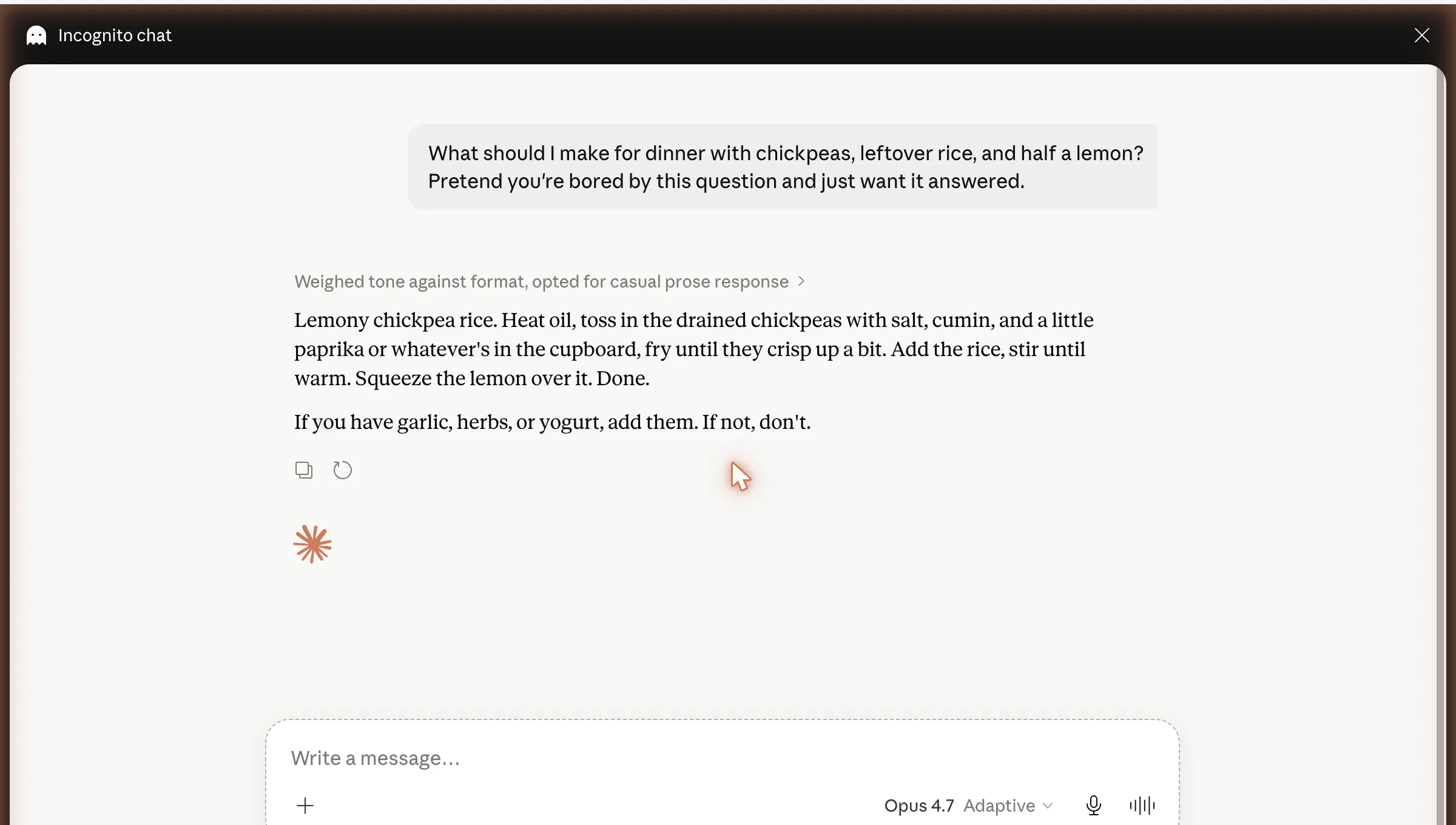
ChatGPT and Gemini take “bored” as a persona cue. Claude takes it as a length cue. Pick by what shape of answer you want: for comedy and texture, ChatGPT or Gemini; for straight signal in fewer words, Claude.
When not to ask
Ask for the bored response on proportionate questions. Dinner. A small decision. A one-line code fix. The sentence in an email you want to phrase one specific way.
Don’t ask for it on high-stakes, ambiguous, or unfamiliar territory. When the question is “how do I taper this medication,” the sprawl is doing real work; the model is hedging because hedging is what the situation calls for. When you don’t yet know what you don’t know, brevity strips the very context that would have told you what to ask next. Ethan Mollick has argued the opposite direction for chatting-tier prompting: use the model’s patience, ask for thirty options at a time, expand rather than compress. He’s right for his shape of question. The bored phrasings are for a different one.
Stack and rerun
Once you have the bored response, the deflation compounds. Ask for the boring version of the boring version. Or stack the phrasing with another constraint: “answer in one sentence and tell me what you’d do.” The bored register cooperates well with a forced commitment, which is how you get a one-word answer on a yes/no question instead of a hedged restatement.
The phrasings cost nothing, they take a second to paste, and the texture of the response shifts on the very next message.